
Field trip recap: Owl Prowl at Marian Byrnes Park
words by Steve Whitman
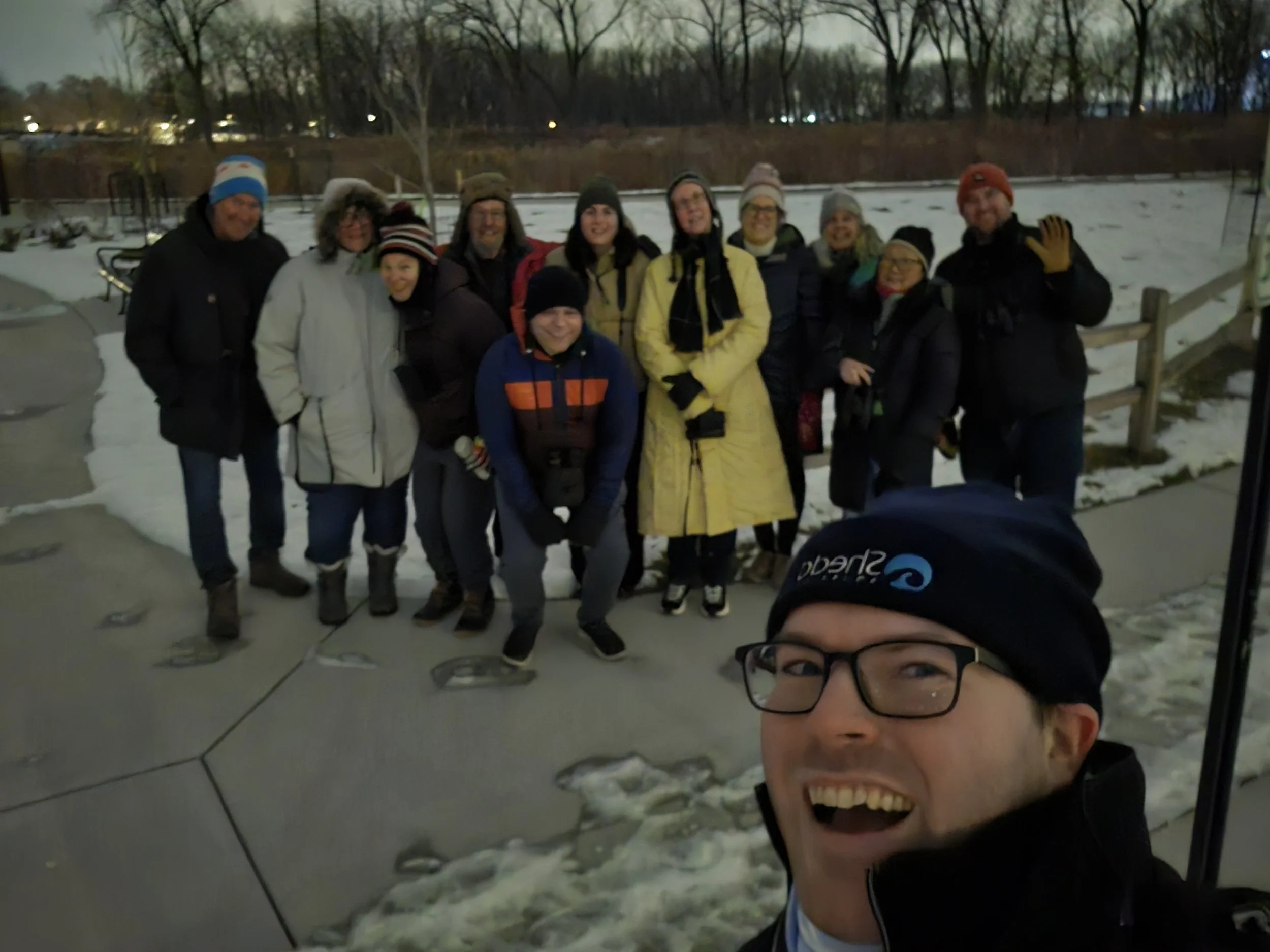
Ten eager birders met COS President Edward Warden at Marian R. Byrnes Park on Dec. 11 for an Owl Prowl. The group learned about owl natural history, ethical observation, and how failing to find a target bird surprisingly enriches birding.
Warden greeted the group and touted the park’s recent ecological restoration and infrastructure developments. After introductions, he listed the owl species that can be observed in the region and explained the ethical ways to observe them. He emphasized no flash photography—even phone camera flash can damage owl eyes.
The party of birders walked north on the snow-cleared paved path, and Warden showed off a new tool for nocturnal birding: a thermal imager. He scanned the prairie and savanna for the warm bodies of birds, or anything, but nothing.
Continuing on, a birder asked Warden where they should be looking. He explained that Eastern Screech-Owls can be found in the bottom third of trees and Great Horned Owls in the upper third. With infinite hope, the group silently scanned the cottonwood trees, but nothing.
Warden instructed the group to use their ears as much as their eyes, and the peaceful silence was only interrupted by the indiscreet howling of a coyote in a nearby neighborhood. On the way back towards the parking lot, Warden described the variety of habitats in the park: in addition to prairie, savanna, and woodland, the marshes provide excellent wildlife habitat.
Owls, or any other bird, eluded the group, but that’s no matter. On another day or night they will bird again, stretching their travels to parks like Marian Byrnes, and one fine morning— an homage to the Great Gatsby may appear.