
Bird Bands in the Wild
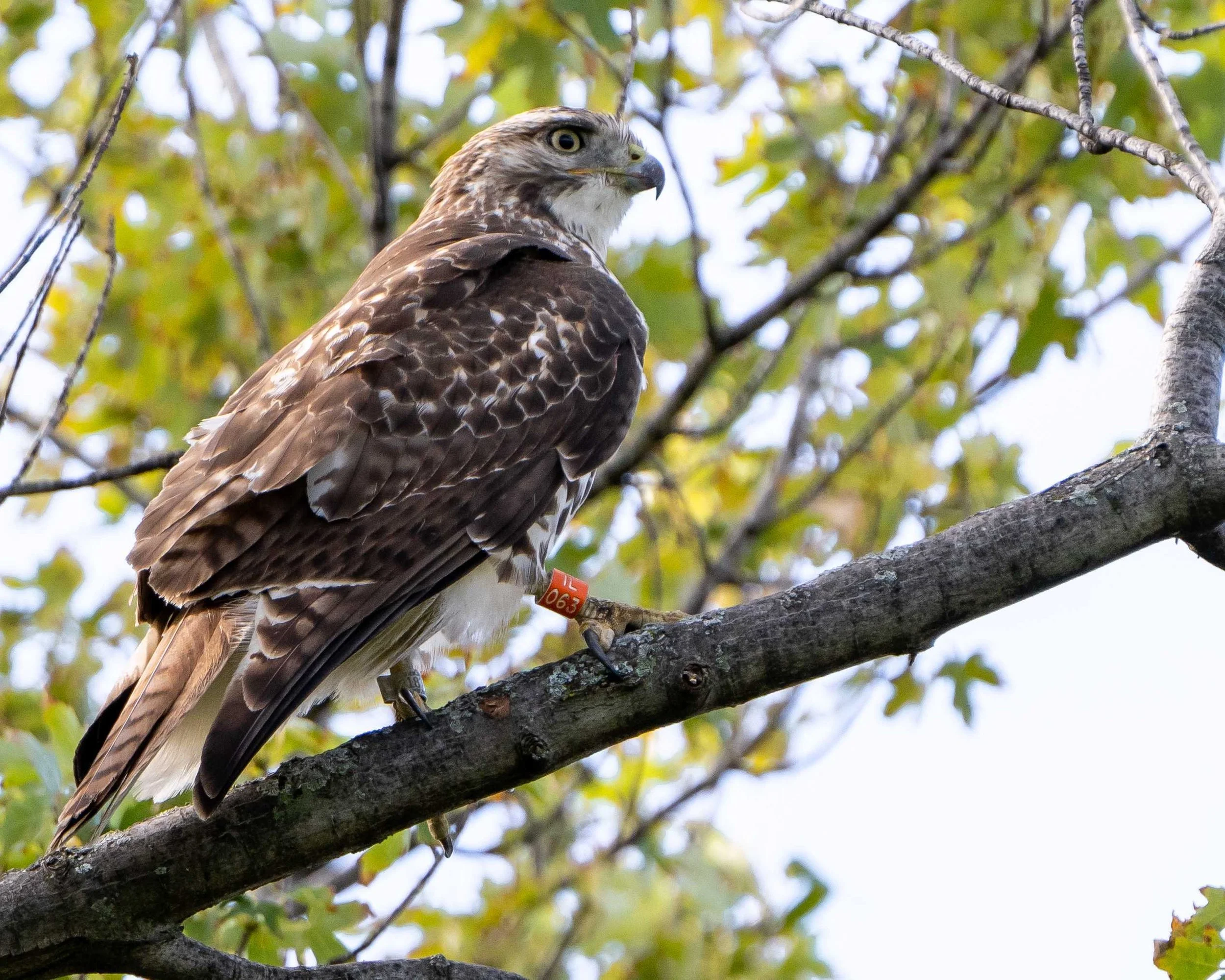
Red-tailed Hawk. Photo by J’orge Garcia.
words by Christina Harber
Have you ever encountered a bird wearing a band around their leg or neck? These bands aren’t the latest avian fashion accessory but rather a way for scientists to identify and track birds. When the public reports banded birds, scientists receive information on bird movement and lifespan. As a birder, you may receive the privilege of knowing that bird’s history which can be quite surprising. These local examples will inspire you to report the next banded bird you see, and if you don’t know how to report a banded bird, we’ll tell you exactly what to do.
A Wanderer from the West
In September of 2025, COS members Pat and Steve Pearson shared photos of a banded Osprey to the COS Facebook group. The Pearsons were excited to come across this banded Osprey while birding in Romeoville along the Centennial Trail. Steve reported the bird to the U.S. Geological Survey (USGS) Bird Banding Laboratory through their band reporting website.
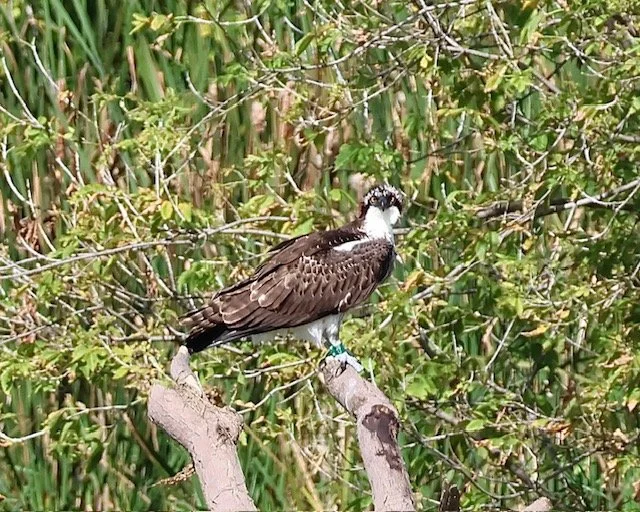
Osprey. Photo by Steve Pearson.
In December, the Pearsons provided an exciting update to the Facebook group. The leg band information they had provided to the USGS was sufficient to identify the bird. They received a certificate stating that the bird (sex unknown) had been banded in July in Billings, Montana. The bird had travelled 1,000 miles to Chicago in their first ever fall migration! Not only did they receive a certificate, but the person who banded the bird personally reached out to them.
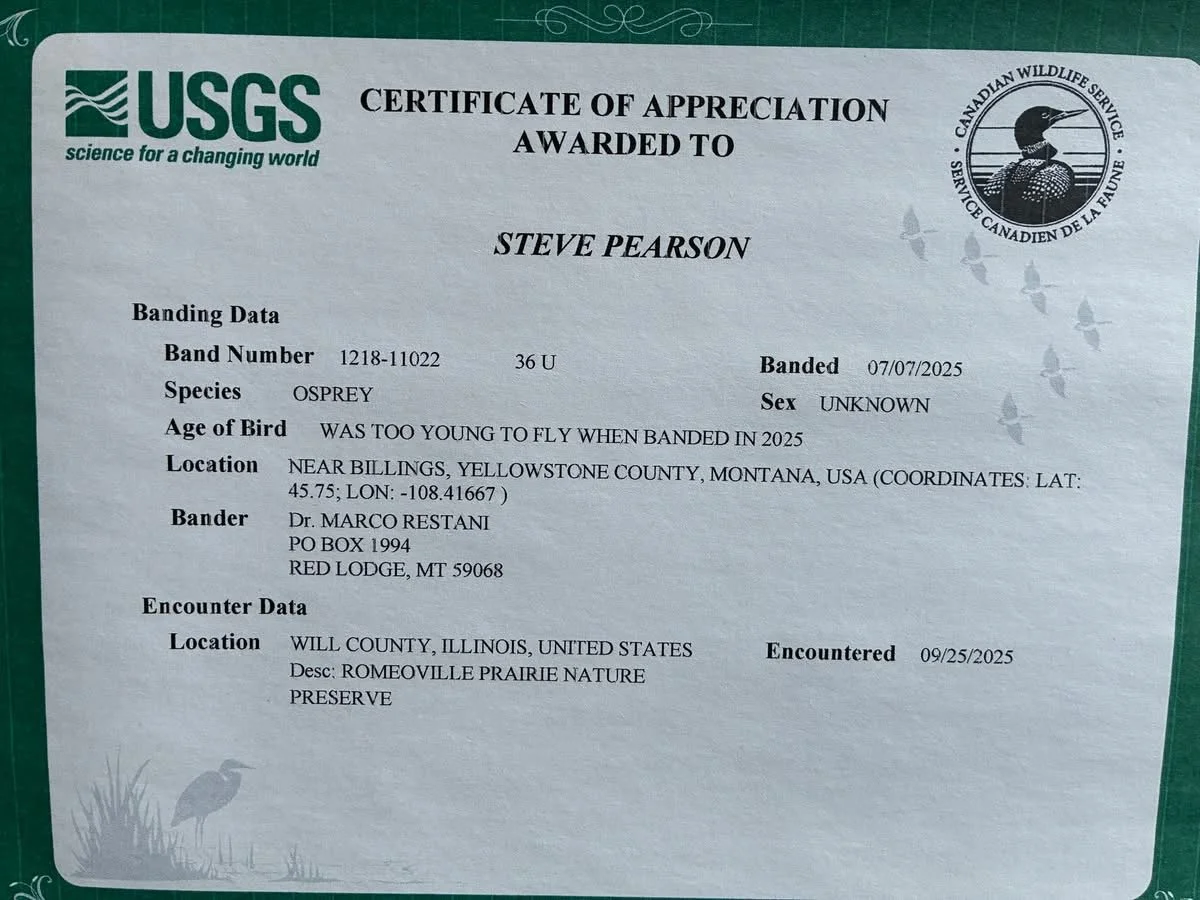
USGS certificate for Osprey band sighting. Photo courtesy of Steve Pearson.
In an email to Steve, the bird bander and researcher, Dr. Marco Restani, commented on the migration tendencies of Ospreys originating in Montana.
“Banded ospreys from our project have wintered along the Atlantic Coast in South Carolina and Florida, and across the entire Gulf Coast from Florida through to the Mexico Yucatan. We have also had a few winter as far south as Costa Rica and as far east as Puerto Rico. Birds on migration have been encountered in Wyoming, Colorado, Nebraska, Kansas, Iowa, Oklahoma, Arkansas, Wisconsin, and Indiana. Your sighting in the heart of the Midwest is unusual, although we did have one banded osprey shot north of you in Wisconsin and one observed in Indiana.”
Dr. Restani banded this individual as part of the Yellowstone Valley Audubon Osprey Project. The Osprey Project relies on the cooperation of utility companies and a team of volunteers to monitor nests. Not only do they observe the nests, but they also improve nest sites and survival for the birds. More information on this truly remarkable project can be found in an article in the Big Sky Journal. Thank you to the Pearsons for sharing their Osprey with the Chicago birding community.
Reporting Chicago’s Bird
In May of 2025, J’orge Garcia, local birder and Founder and Director of the Windy City Bird Lab, was working on the roof of the Willis Tower to install a Nocturnal Flight Call Monitor system when he saw two Peregrine Falcons flying around. J’orge was able to capture a great photo of one of the Peregrines and could read the leg band. After reporting the bird to the USGS site, J’orge received a certificate with basic information on the bird, a male that had been hatched two years prior in Illinois. We reached out to Mary Hennen, Director of the Chicago Peregrine Program, for more details which she generously shared.
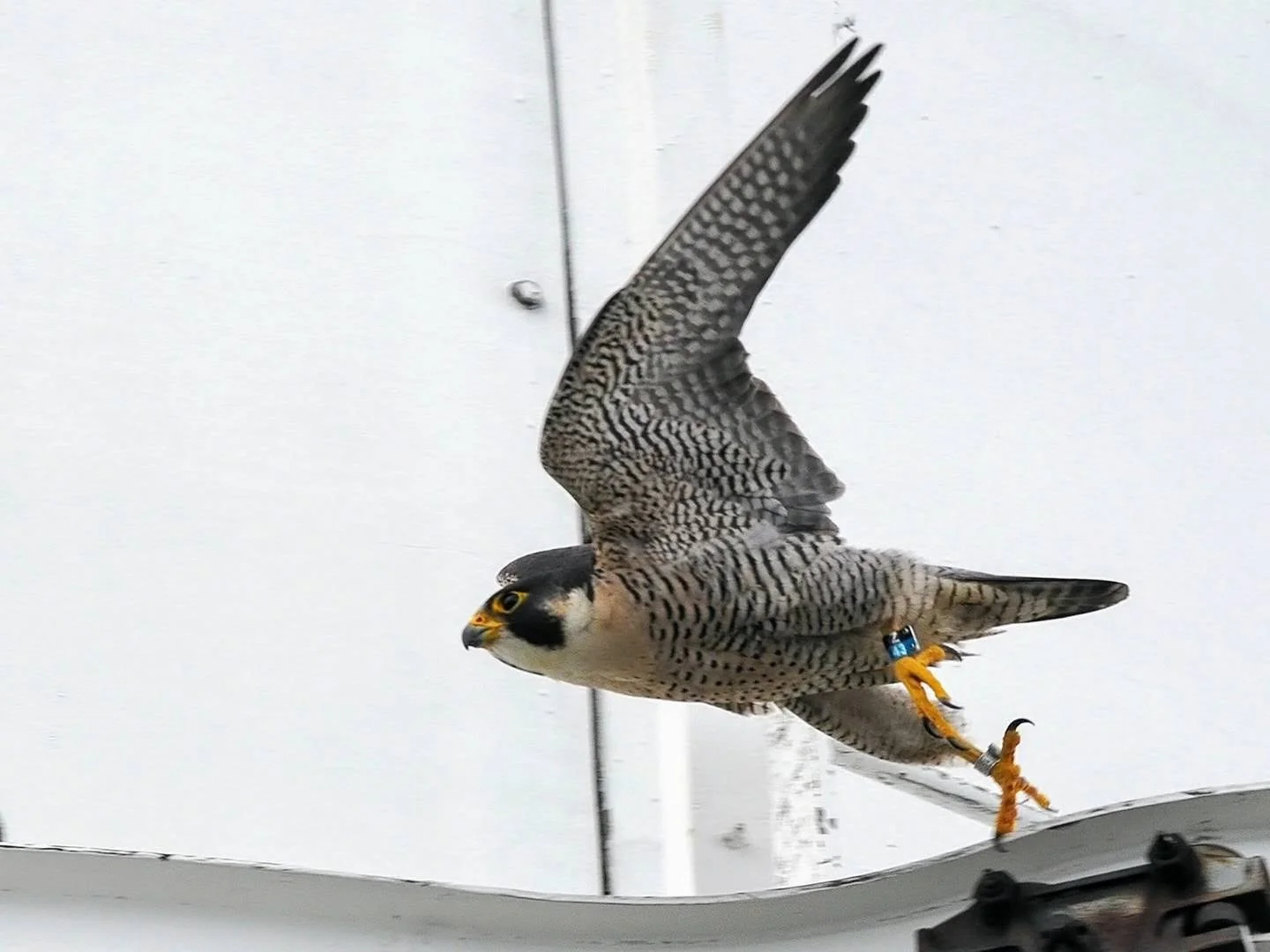
Peregrine Falcon. Photo by J’orge Garcia.
“The bird's name is Harrison and I banded him out at the Harrison/Dever Water Crib in 2023. Last year he held the Wacker territory in Chicago, paired with a female named Lisa. Lisa fledged from a nest in Green Bay back in 2009 and has held the Wacker territory since 2014. Last year (2025) the pair did not nest.”
While it cannot be known for certain why the pair did not nest last year, their ages may have been a factor. Harrison was a less experienced bird and Lisa was on the older side and less competitive with younger females. However, it would not be unheard of for a pair of their ages to nest.
Anyone observing a banded Peregrine Falcon is encouraged to contact Mary Hennen at mhennen@fieldmuseum.org. Supply the band color and text, sighting date and location, and photos if possible. These public observations provide researchers with crucial information on the species that can lead to more effective conservation efforts.
The nesting population, once erased from Illinois due to the pesticide DDT, rebounded due to conservation efforts and nesting in an unlikely place—the rooftops of skyscrapers. For a history of the Peregrine in Chicago, read our blog post from 2024, the 25th anniversary of Chicago electing the Peregrine as the city’s official bird.
The Author’s Sightings
I’ve had my own sightings as well. In October of 2023, I reported a Red-tailed Hawk in Garfield Park while birding with Chicago BIPOC Birders. J’orge Garcia took a very crisp photo showing an orange band on the right leg of the hawk with text “IL063” making the hawk easily identifiable. According to the certificate I received, he (it’s a boy!) had hatched earlier that year and was banded in Oregon, Illinois. At the time, I thought that was a long journey for his first migration. It turns out, it was just a short flight compared to the Osprey reported by the Pearsons!
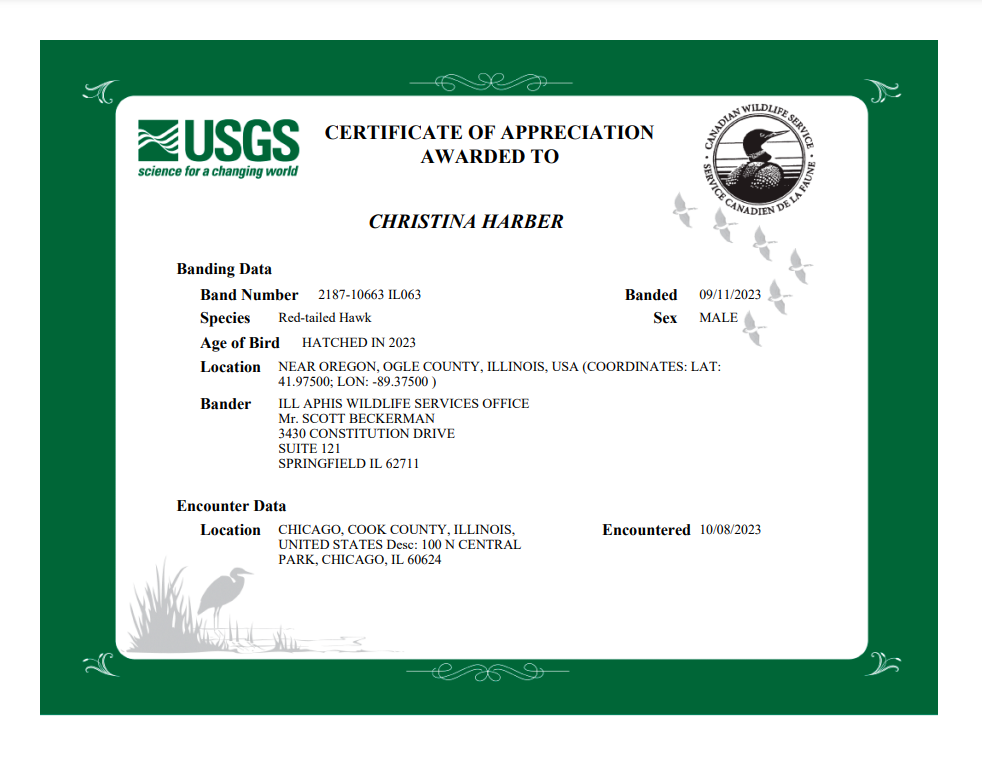
USGS certificate for Red-tailed Hawk band sighting.
I’ve also reported a Canada Goose while leading a trip in Garfield Park as part of The Urban Birding Festival in September of 2025. The goose wore a neck band, which unlike the leg bands on a raptor, are easy to read. I received a certificate that the goose was 9 years old and had been banded in the Cook County area.
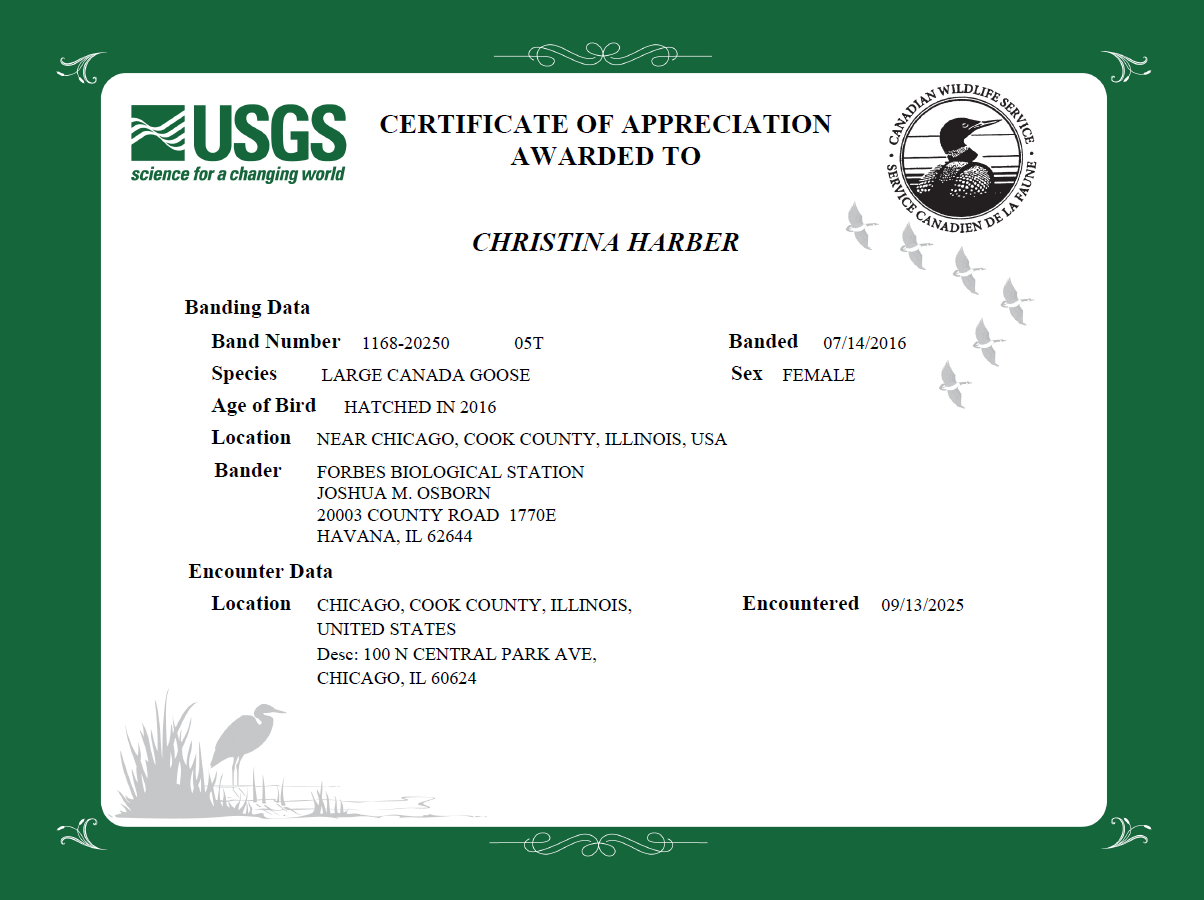
USGS certificate for Canada Goose band sighting.
How to report a banded bird
Visit reportband.gov. You’ll report the species (if known), location, and date and the condition of the bird (live, dead). You’ll report information on the bands. There are two types of bands. Federal bands are worn on the leg and made of metal. The numbers on these bands are difficult to read on live birds. If you can’t provide the numbers from these bands, the bird may be more easily identifiable from a second set of bands that are colored and made of hard plastic. These bands are typically found on legs or necks. Note where the band is (e.g., “left leg”), the color of the band, the color of the text, and the text on the band (can be alpha numeric).
Bird banding and tracking gives researchers insight into the state of bird populations, which can be used to support conservation efforts. For regular birders, it gives us a glimpse into the secret lives of birds. Rarely do we know their origins, how far they’ve traveled, and what they’ve experienced to survive. The next time you observe a banded bird, be sure to share!