
Help Reduce Bird Collisions
words by Danny Miller
Springtime is here, which means millions of birds are returning north after the winter. Over the next few weeks, around 49 million birds from as many as 300 different species will migrate through the Chicagoland area, typically peaking between late April and early May. The city is at the center of the Mississippi Flyway, one of the most heavily-trafficked migration routes for birds in North America. Many of these birds travel at night, when lower temperatures help conserve energy and the darkness helps smaller birds avoid detection from predators. Last year, as many as 3.5 million birds flew through Cook County in a single night!
While this is a welcome occurrence for bird enthusiasts around the Midwest, the city poses several risks to these birds. The city’s light pollution is the worst in the United States, with its alluring glow distracting birds that use the stars and the moon to help navigate and increasing stopover frequency.
Birds visiting or flying through the city are in danger of colliding with glass windows on the countless buildings in both the downtown area and surrounding neighborhoods. Since 2010, the Chicago Bird Collision Monitors (CBCM) has collected over 82,000 birds who died after colliding with buildings in the downtown area alone. Over the past five years, CBCM has recorded an average of over 7,500 bird deaths per year, and this is almost certainly an underestimate of the true annual total.
When poor weather conditions occur during peak migration, the results can be catastrophic. On the night of October 4, 2023, a storm rolled in while as many as 1.5 million birds were flying through the city, prompting them to fly at a lower altitude than usual and increasing their risk of colliding with buildings. The next morning, CBCM collected over 2,000 dead birds, including nearly 1,000 that died after colliding with a single building: the McCormick Place Lakeside Center.
The McCormick Place Lakeside Center, or McCormick Place, is one of the most extensively studied buildings in the world, thanks to the work of David Willard. Since 1978, a team of researchers led by Willard, formerly of the Field Museum, has counted and collected dead birds from McCormick Place every morning during spring and fall migration. With 120,000 square feet of glass on its exterior, the building has been the cause of tens of thousands of bird deaths. This careful work provides comprehensive data on the impact a single building can have on bird mortality, revealing trends in collision deaths as well as the effectiveness of various solutions the building’s owners have implemented since the study began.
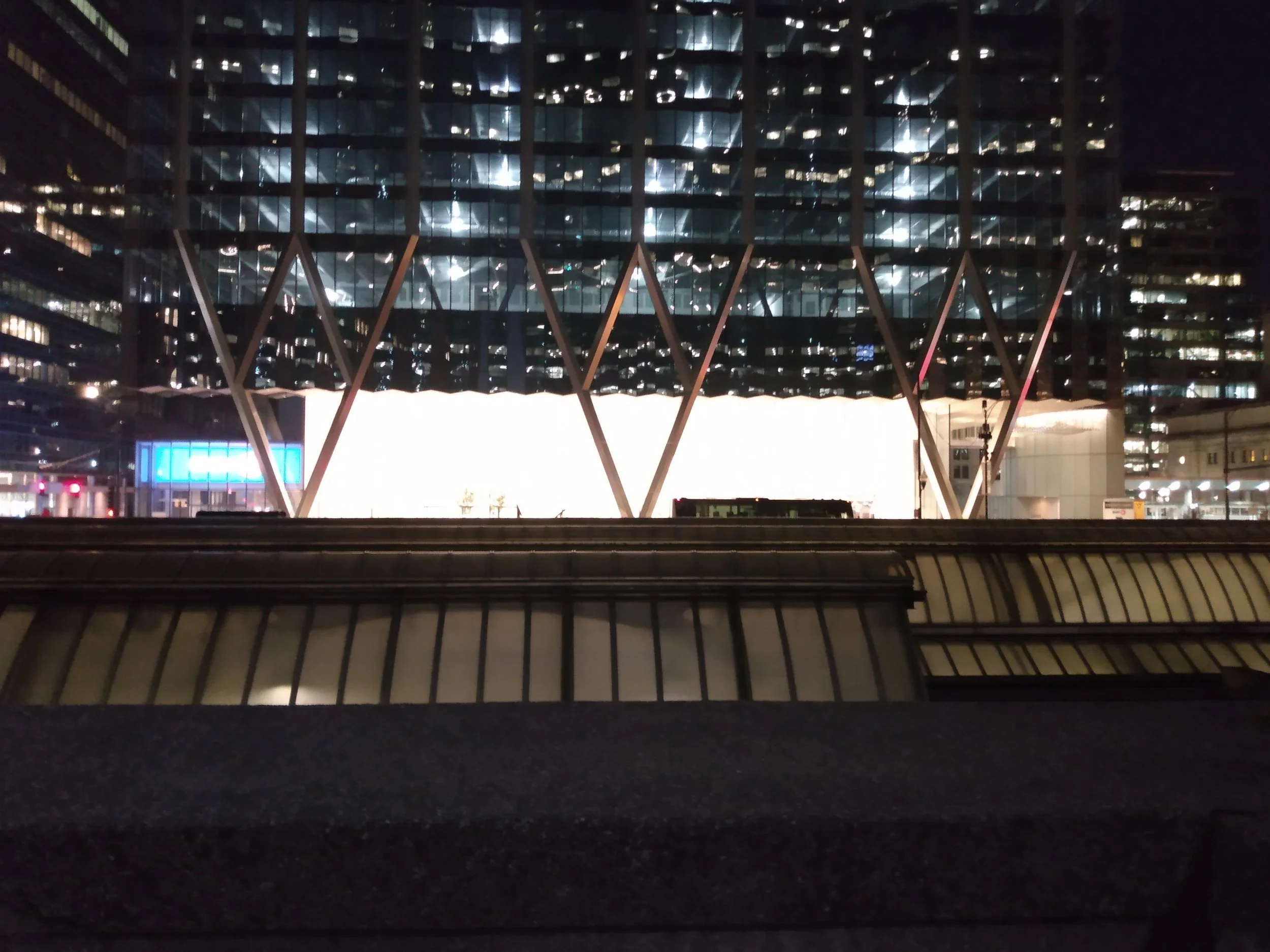
320 S. Canal, a common site of bird collisions, with its lobby lit during the early morning hours of November 2, 2022. Photo by Robyn Detterline
Solution 1: Turning Off or Limiting Artificial Light at Night
The first—and cheapest—solution for preventing bird collisions is to curb the amount of artificial light used during migration seasons. This can be done by simply turning off or reducing interior and exterior lights, lowering the temperature of lighting to be softer and warmer, or installing curtains to prevent interior light from being visible outside. McCormick Place began turning off its lights at night in 1999, after which bird deaths declined by 55 percent.
How Can This Be Implemented at Scale?
The simplest way to prevent building collision deaths is to follow city regulations aimed at reducing artificial light. While the Lights Out Chicago program is a great start, participation in this program is voluntary, and would be more effective if mandated by legislation. Furthermore, it only applies to buildings that are at least four stories tall, or those that are isolated and at least twenty stories tall. Studies have shown that less than 1% of collision-related bird deaths occur at high-rise buildings, demonstrating the importance of expanding this program beyond the downtown area.
You can help reduce collisions by turning off or shielding lights in your own home or apartment at night. 44% of bird deaths occur at residences, and unfortunately for the bird-lovers among us, the collision rate is higher at homes with bird feeders
Streetlights are another important source of artificial light, but they are not addressed by the Lights Out program. Thanks to advances in both migratory bird tracking and artificial intelligence technology, streetlight intensity and volume can be automatically reduced on peak migration nights throughout the city. Just as migration volume often fluctuates wildly from night to night, bird collision deaths are also clustered around just a handful of nights when migration activity is high. Since 1978, 50 percent of bird collision deaths at McCormick Place have occurred on just a quarter of the nights in each migration season. In 2023, even excluding the mass mortality event on October 4, more than 50% of bird deaths took place across just twelve nights out of the 210 studied during the spring and fall migration seasons.
As our ability to study bird migration has improved, these nights have become easier to predict. With tools such as Cornell Labs’ BirdCast, which uses weather radar to estimate the number of birds in flight, migration forecasts are available three nights in advance. BirdCast even has an alert subscription service that notifies subscribers when migration is high and reducing artificial light is of extra importance. By signing up for these alerts, building managers, city planners, and community members can all help reduce lighting throughout the city on peak migration nights.

A window treated with Feather Friendly Film. Photo by Robyn Detterline
Solution 2: Adding Visible Patterns to Windows
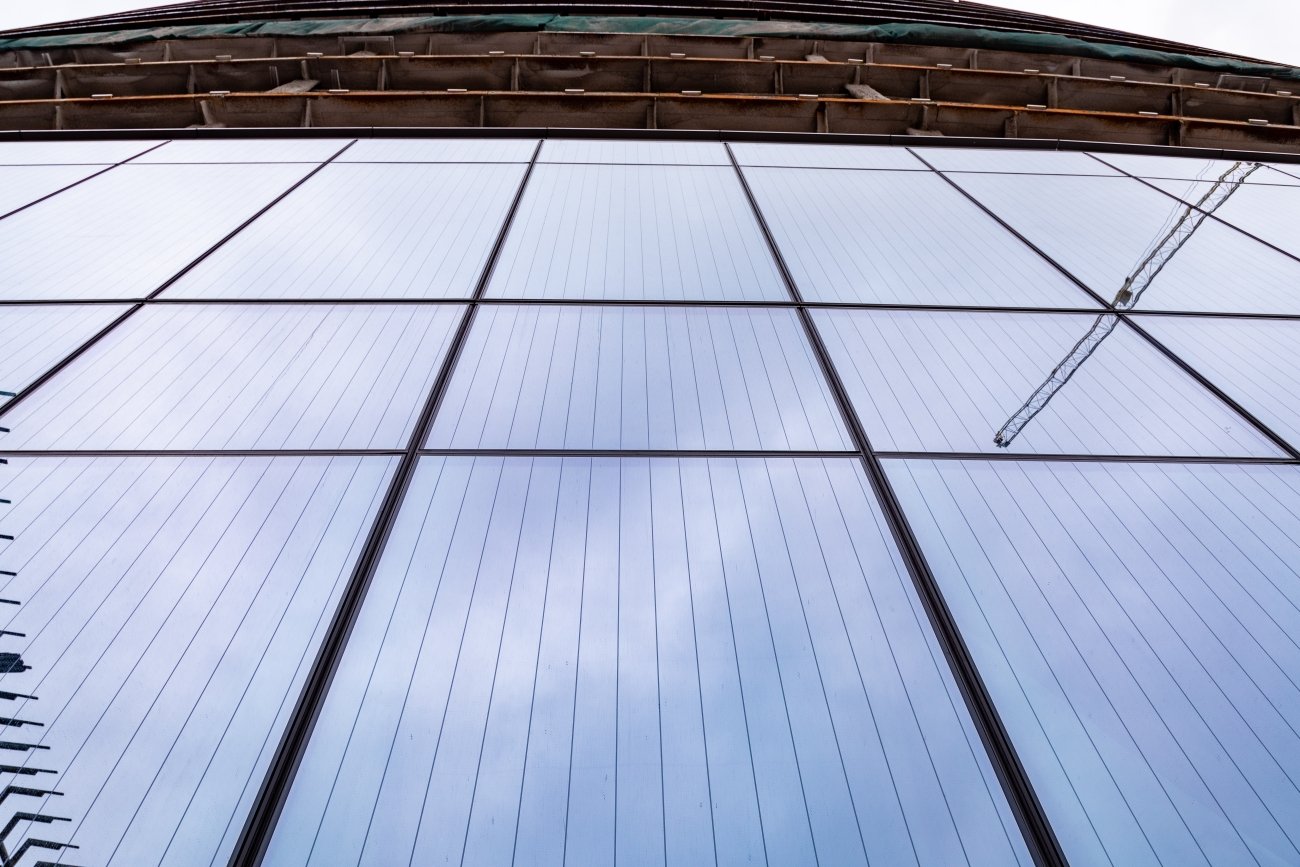
An even more effective solution is to install patterned windows that make glass more visible to birds. Following the mass mortality event in 2023, McCormick Place retrofitted its windows with bird-deterring transparent film produced by Feather Friendly, a company based in Toronto, Canada, that manufactures products that make windows safer for birds. This project, which cost $1.2 million, drastically reduced bird collision deaths from an average of 375 deaths per fall migration season from 1999 to 2020 to just eighteen deaths in the fall of 2024. This is a 95 percent reduction from the annual average and a 98 percent reduction year-over-year.
These results are consistent with similar efforts in New York City and British Columbia, Canada, which also saw bird deaths fall by over 90 percent, proving how effective patterned glass can be at reducing bird collisions.
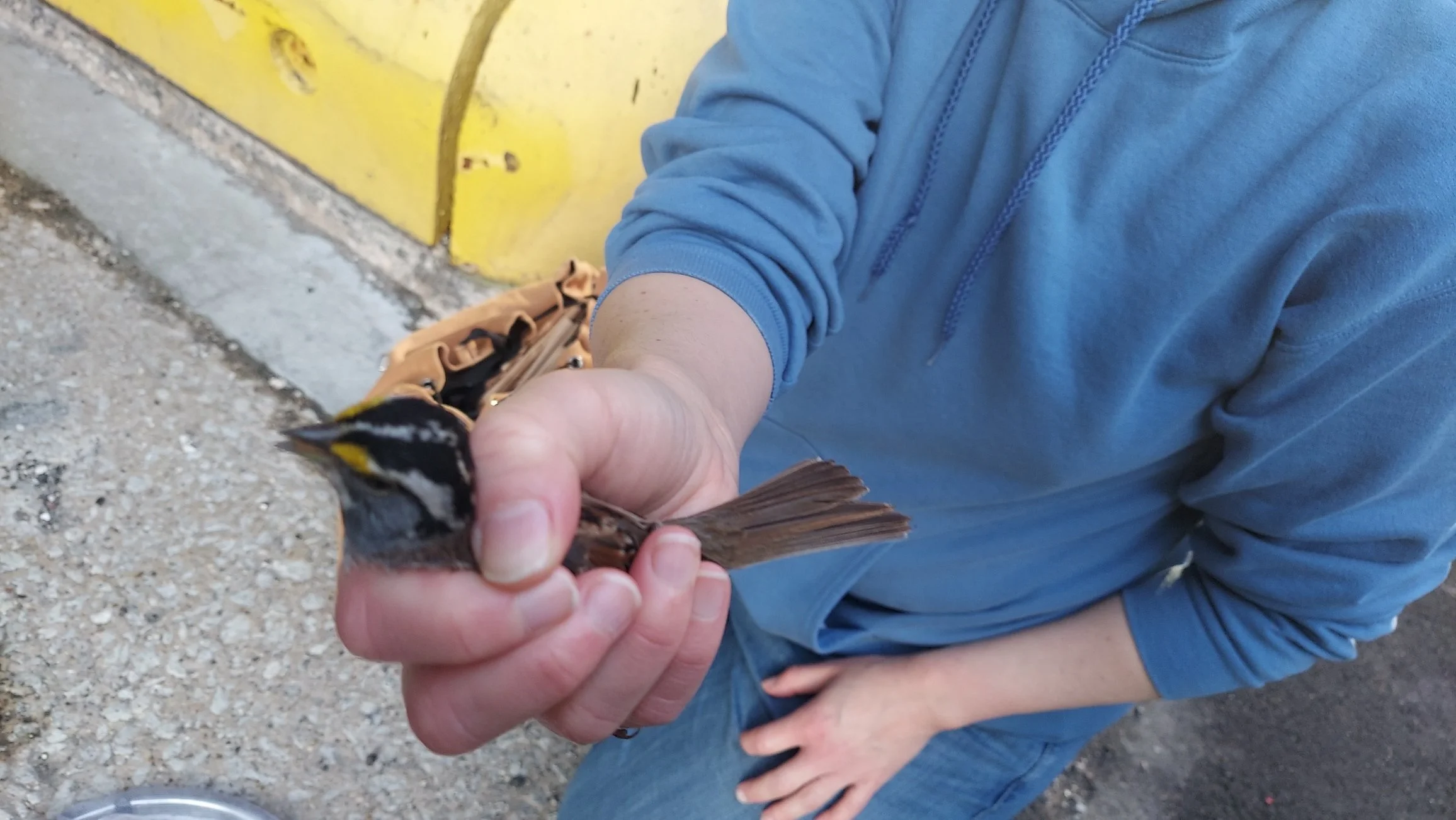
A White-throated Sparrow, who collided with a window at 600 W. Fulton on April 29, 2026, rescued by a CBCM volunteer. Photo courtesy of Robyn Detterline
How Can This be Implemented at Scale?
Applying bird-safe patterns to windows is more difficult to implement at scale than reducing artificial lighting, but not impossible. The cost of retrofitting existing windows with bird-deterring film can be high and likely can’t be realistically implemented on every building in the city, but bird collisions are often clustered around a handful of buildings in each city, and sometimes even just specific sides or sections of certain buildings. City funds could be designated for a study that determines which buildings have the highest frequency of bird collision deaths, and additional funds could be used to retrofit their windows with bird-safe patterned film. Additionally, the city could pass legislation that would require new construction sits to install bird-safe patterned glass, such as that made by the Chicago-based company Skyline Glass. This would come at a marginally higher cost to building developers and would be much cheaper than retrofitting windows on existing structures with bird-safe patterns.
Lastly, community members such as you can also contribute by making your own home or apartment bird-safe! Feather Friendly produces DIY kits you can use to add patterns to your windows, or you can simply use masking tape or other materials to mimic these patterns and make your windows more visible to birds. Together, we can all make the city a little safer for our feathered friends, whether they live here or are just passing through!