
Always Be Counting: The Lisle-Arboretum CBC

2019 Lisle-Arboretum CBC participants at Lyman Woods.
words by Jennifer Mach
The Christmas Bird Count (CBC) might be one of the ultimate if-you-know-you-know events in birding, because if you don’t know, it might sound like a very long, potentially very cold slog at a time of the year that’s not known for birding. Well, spring migration it ain’t, but if you know, then you know…that the CBC is a day of surprises (good or bad), community science, and camaraderie with a group of birders who are tight-knit, yet very welcoming to new birders. And here in Chicagoland, we are fortunate to have one of the oldest and best-attended CBC events, the Lisle-Arboretum CBC.
The History
The CBC was started in 1900, when ornithologist Frank Chapman from the American Museum of Natural History proposed to count birds as an alternative to the “side hunt” tradition of shooting birds. The first CBC had 25 counts and 27 birders across the U.S., from Central Park in New York City to Pacific Grove, California. The results of each count were reported to the Audubon Society and published in Bird Lore magazine, “The Official Organ of the Audubon Societies.” Indeed National Audubon has a scanned archive of Bird Lore, albeit with some gaps, and other issues of Bird Lore are available on HathiTrust.
Illinois birders were active in the early CBCs. For example, the 27th CBC report in Bird Lore (1927) has reports from eleven Illinois towns. For the Chicago count, Clarence Palmquist scouted Lincoln Park, Rosehill Cemetery, Peterson’s Nursery (whose land eventually became North Park Village Nature Center) and Forest Glen, covering eight miles on foot and ten by auto, and reporting 132 individuals of 8 species. The 28th CBC report in Bird Lore (1928) had reports from ten towns across Illinois. For the Chicago report, four intrepid birders documented 759 individuals of 25 species, including 500+ goldeneyes, 41 tree sparrows, 22 chickadees, and a Long-tailed Duck.
The Illinois Audubon Bulletin has a CBC report from the Morton Arboretum CBC in 1932, although this issue of Bird Lore does not appear to have been scanned into online archives. In the 1932 count, four birdwatchers birded for almost three hours in the cold (cloudy and 25–27°F) and noted five species: Tree Sparrows (28), Slate-colored Juncos (11), crows (3), Downy Woodpecker (1), and Pine Siskins (8). The report includes a delighted description of some very cooperative Pine Siskins from observer Carlyle Morris: “I believe this is the first time I have ever positively identified this species and so got quite a thrill.”
After 1932, Lisle-Arboretum CBCs were sporadic (or perhaps sporadically reported in time to make the CBC issue of Bird Lore) and didn’t become an annual tradition until 1956. For the 57th CBC in 1956–1957, the Lisle-Arboretum attracted 27 birders in 5 parties, who logged almost a thousand individuals in 45 species, including five types of hawks and three types of owls (Great Horned, Long-eared, and Saw-whet). Participants were listed as “members and guests of the Chicago Ornithological Society” and included Dr. William J. Beecher and then-COS president Alfred Reuss, Jr. The popularity of this CBC has grown since then, with recent counts including 80–100 birders.
Count Protocol
In the early days, birders would cover whatever terrain they liked on a date around Christmas. Now, each CBC area covers a circle 15 miles in diameter and a timeframe of one day within the CBC period, which runs from December 14 to January 5. The Lisle CBC is held on the first Sunday of the count period, which happens to be December 14 in 2025, and will be the 77th Lisle-Arboretum CBC.
The count circle for the Lisle-Arboretum CBC is centered in Darien, IL, at the intersection of Cass Avenue and 75th Street. This circle includes a diverse set of habitats and birding hotspots such as the Morton Arboretum, Fullersburg Woods Forest Preserve, Argonne National Laboratory, Waterfall Glen Forest Preserve, Saganashkee Slough, Bullfrog Lake Forest Preserve, the Little Red Schoolhouse Nature Center, Cap Sauers Holding, and Swallow Cliff Forest Preserve. In addition to these forest and grassland habitats, the circle includes parts of the Des Plaines River and Cal-Sag Channel that do not freeze over in cold weather, offering opportunities for fish-eating birds such as Bald Eagles. The 2015 count spotted 17 Bald Eagles; perhaps 2025 can beat that.
The participants in the Lisle-Arboretum CBC do not cover the entire 175 square miles encompassed by that circle; rather, they are assigned in groups to areas and sub-areas within the 15-mile circle by coordinator Carl Giometti. He assigns participants to specific groups and groups to specific sub-areas, making sure to match experienced and new CBC participants to ensure the best coverage and the best experience. Returning CBC participants, of which there are many, are generally assigned to the same sub-areas each year, allowing them to become familiar with every owl roost, popular snag, tree with persistent berries, hiding spot, and other potential birding location.
On the day of the count, many groups begin with a little owl prowl at 4 a.m. According to Carl, because veteran CBC participants know each sub-area very well, this presents a great opportunity for newbies to see owls, particularly Eastern Screech-Owls and Great Horned Owls, which are the two species most commonly reported in this CBC. Each group has its own traditional routes and routines within sub-areas, but many groups will break after owling for a quick breakfast and warm-up, before hitting the woods for early morning bird counting. Each group has traditional, favorite spots for lunch (possibly White Fence Farm and its famous fried chicken). Because the sub-areas are relatively small, many groups will circle back to areas more than once, just to catch species they might have missed. The counting ends around 5 p.m., when birders repair to the post-count dinner, possibly with a stop to look for owls again, just in case that Snowy Owl or Barn Owl turns up.
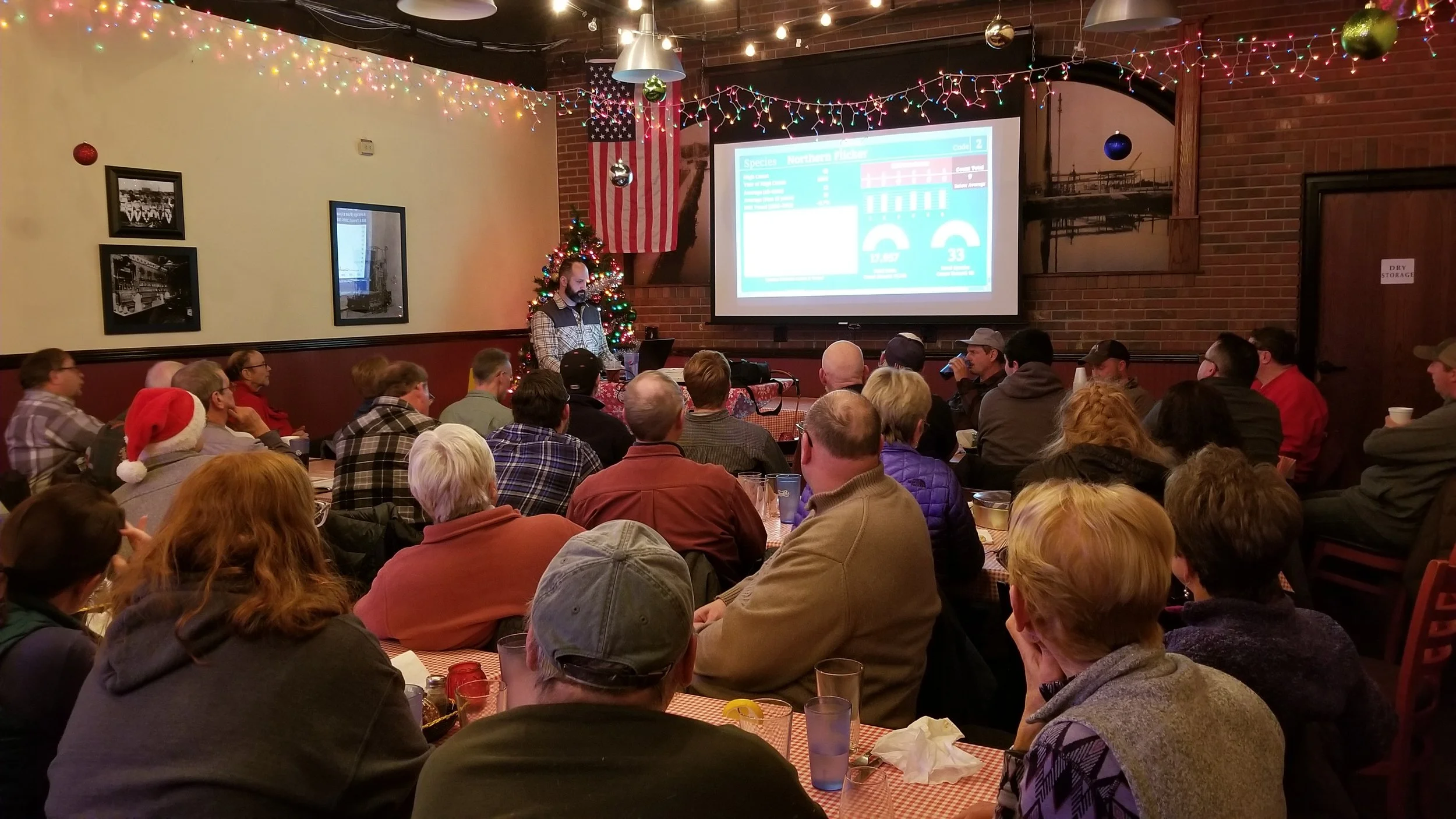
The 2019 Lisle-Arboretum CBC post count dinner.
The post-count dinner and count compilation at Imperial Oak Brewery Brookfield is optional, but according to participants, not to be missed (if you know, you know!). Alas, the Piping Plover Ale will probably not be on tap, but there will be plenty of food and drink to fortify yourself with as birders from different groups compare sightings, commiserating or celebrating, and the coordinator compiles the data collected by each group. Data compilation is a festive event, as the leads for each sub-area shout out bird counts to be tabulated by the coordinator, who also serves as ringmaster for a friendly competition—who counted the most birds and found the most, and the most-rare birds? Birds are separated into codes 1–4, with code 1 species being those that are widespread and seen most years (hello Canada Geese, crows, nuthatches, and Downy and Hairy Woodpeckers), and code 4 species being those that are almost never seen.
Whether it’s a boom year, or a bust year (in which, as Carl recounts, “the birds were so damn slow, we started counting planes,”) the compilation will likely offer some excitement, with rarities or large numbers of birds of a specific species. For example, compiler Carl Giometti and frequent participant Edward Warden reminisced about years when multiple flocks of Sandhill Cranes flew over during the count—maybe this was in 2011, when the count reported 1,367 Sandhill Cranes. That may sound like a lot, but consider the year 2000, when the count tabulated a honking 18,494 Canada Geese.
In terms of rarities, don’t give up on warblers just because it’s December; previous counts have reported a Common Yellowthroat, a Palm Warbler, and a Pine Warbler—that will really rile up the data compilation party. Birders always hope for an irruption and, although Snowy Owls have been remarkably infrequent in the Lisle-Arboretum CBC, participants did record 590 Pine Siskins in 1971. As Chicagoland Cubs fans know, this could be the year! For rare birds, not the Cubs, sorry.
Citizen Science
After the coordinators compile the CBC data, they report the data to the National Audubon Society, along with information on the numbers of participants and the distances covered. The person-miles metric is used to standardize the bird counts by effort, increasing the reliability of the data. Because of its standardized methodology and long history, the CBC has provided a remarkable wealth of scientific information that has allowed researchers to examine the effects of climate change, habitat loss, disease, and other factors on bird populations worldwide. CBC data has documented declines in species from Loggerhead Shrikes to House Sparrows, northward shifts of species such as the Purple Finch and Northern Flicker, and southward shifts of species such as ravens.
Although many species have declined, the CBC has documented increases in species such as Merlins and Pileated Woodpeckers, the latter possibly capitalizing on the dead tree and insect opportunities produced by changes in forestry management, such as leaving dead trees in place rather than clearing dead wood out of forests.
Other hopeful trends are the recovery of raptor numbers after DDT was banned in the U.S., and the increasing numbers of corvids following the devastation of West Nile virus. Whatever the trend, the remarkable community science produced by hearty, dedicated CBC participants has made many valuable contributions to bird research.
Want to get involved? The 2025 Lisle-Arboretum CBC will be held on December 14, 2025. You can email the coordinators at cbc@chicagobirder.org to sign up (Act fast—the RSVP deadline is December 1.)—and if that CBC doesn’t work for you, there are multiple CBCs around Chicagoland, including the lakefront, Evanston, and other locations. Maybe you, too will experience some delightful Pine Siskins, or an abundance of Sandhill Cranes. And whether the birds are abundant or scarce, you will likely experience the fun of being out with like-minded birders and contributing to important community science!
Thanks to current Lisle-Arboretum CBC compiler Carl Giometti, previous compiler Geoff Williamson, Morton Arboretum librarian Rita Hassert, Audubon staffer Cooper Farr, and CBC attendee/compiler Edward Warden for their assistance in compiling information for this article.